
Just wanted to share my recent certification. It's a step that demonstrates my commitment to excellence in the organizing industry. If you’d like to learn more about this credential, click here.

The Tyranny of Clutter
“We hold these truths to be self-evident, that all men are created equal, that they are endowed by their Creator with certain unalienable Rights, that among these are Life, Liberty and the pursuit of Happiness.”
These words were penned as the colonists of 1776 sought and fought for freedom. The British Parliament made every attempt to thwart their success. Following the Boston Tea Party, they established military rule in Massachusetts, even requiring the colonists to house British troops. Freedom wasn’t just a theory for political discussion, it dramatically altered their quality of life and revolutionized the future. That’s what freedom does.
Freedom, as defined by Merriam-Webster is:
the absence of necessity, coercion, or constraint in choice or action
the liberation from the power of another
the state of being exempt or released usually from something onerous
unrestricted use
Despite the freedoms we now enjoy as a result of our nation’s independence, there are other issues that have potential to enslave us. Could freedom from the tyranny of clutter alter your quality of life and revolutionize your future?
Today's Timely Tips take a look at the definition of freedom as applied to a cluttered environment and offer four points to consider when choosing freedom.
Timely Tips - for freedom from the tyranny of clutter

Freedom is the absence of necessity, coercion, or constraint in choice. Is clutter constraining your choices?
Can you choose to have people over whenever you desire? Does clutter keep you from hosting at holidays?
Can you choose what to wear from your entire wardrobe, or are the clothes piles reducing your options?
Would you like to move, but feel anchored in place by your clutter?
Do you feel coerced into paying for additional storage?
Freedom is the absence of necessity, coercion, or constraint in action. Is clutter constraining your actions?
Are unable to pay your bills on time due to paper piles?
Have you given up on your hobby because your craft room or garage is a catch-all?
Are you postponing a vacation or social activities because you feel like you should rather be home clearing the clutter?
Freedom is the liberation from the power of another. Do you need liberation from powerful behaviors?
Is shopping therapy your go-to when you need a quick pick-me-up?
Do you hang on to everything in case you or your kids might need it someday?
Does guilt over what you spent on stuff keep you from letting it go, even when you’re not using it?
Freedom is the state of being exempt or released usually from something onerous. Is the thought of decluttering onerous?
Do you feel overwhelmed?
Are you drowning in your clutter?
Do you long for a clutter-free existence, but it seems like an impossible task?
Have you tried and failed?
Freedom is unrestricted use. Is clutter restricting the functionality of your home?
Is it impossible to complete a task without spending hours looking for something you need and know you own, but can’t find?
Are you using only the front layer of things in your cabinets or freezer, because they’re impacted and you have no idea what’s in the back?
If you answered "YES" to any of the above, then your freedom is constrained by your clutter. Here are four points to consider when choosing your freedom.
1. What’s contributing to the problem?
Behaviors, habits and routines or lack thereof
No systems in place
No established homes for things
No criteria for letting go
Lack of organizing skills
Physical or emotional challenges
Other
2. What do I need to combat the clutter?
Designated time for project planning and implementation
Clear how-to instructions for decluttering and creating homes and systems
Disperse, dispose, and donate discards
Commitment to follow through and maintenance
3. What do I do when that’s not enough?
Stop beating yourself up for not being able to do it on your own—that’s counterproductive.
Get help! Not all of us play piano by ear or have technical talents by nature. Neither are we all natural-born organizers. When we need skills that aren’t instinctive, we get help.
Sometimes friends and family can help, but other times they can be pushy and judgmental in the process. A professional organizer offers expertise and hands-on assistance with patience and understanding.
4. You have a choice!
You aren’t trapped in the tyranny of clutter.
Change is possible even in the most contrary conditions.
Choose to be free today!

To locate a professional organizer in your area, go to the National Association of Productivity & Organizing Professionals website: NAPO.net. In the California Central Valley you may contact me at (559) 871-3314 or at info@organizedbychoice.com .
WISE WORDS
Every human has four endowments - self awareness, conscience, independent will and creative imagination. These give us the ultimate human freedom... The power to choose, to respond, to change. --Stephen Covey

What do your books deserve?
My granddaughters LOVE books! I recently pulled out the American Girl series that belonged to their mom when she was little. While reading Meet Samantha to them, I realized my heart connection to that series wasn’t the books themselves, it was to the era of life with my own book-loving children.
Even though I wouldn’t call myself an avid reader, I still love books and probably have a few too many. How about you? Are books spilling off your shelves? Are there boxes of books in your garage or storage? What is this connection we have to books and why are we so resistant to letting go?
Laura Lippman is a novelist. In her article, “The Book Fairy,” (Real Simple Sept. 2018) she presents an interesting observation. People tend to define us by what they see on our bookshelves. From the time she left college with six cartons of books, she continually added until, at one point, her home, a storage unit, and the anteroom in her office were full.
Early in 2017 something changed. “I found myself looking at my shelves and realizing they were not, in fact, a mirror,” says Lippman. “If anything, they were a carefully curated and alphabetized lie.” The question changed from “What do my books say about me?” to “What do I have to say about my books?”
“Books,” Lippman decided, “deserve to be read, not preserved on shelves where they won’t be cracked open again in one’s lifetime.” She developed a clever and somewhat mysterious way of sharing her books. “It’s a mitzvah to pass along titles that I love,” she says, “a way of playing matchmaker between great writers and avid readers.” You can read about it online at www.realsimple.com/work-life/how-to-get-rid-of-books.
If, like Lippman, you’re ready to give your books what they deserve, follow these five Timely Tips.
Timely Tips - to organize your books

1. SPACE - Determine ahead how much space you're willing to allot to books. Maybe it's one or two books shelves. Maybe it a room devoted as a library. You decide and then choose to live within those boundaries.
2. PURGE & SORT - Rule #1: Don’t start reading as you’re organizing. You’ll never finish the job!
Remove the books from their shelves, boxes, piles, etc. Sort into keep, donate, and sell (if desired). Criteria for books to keep might include rare/collectibles, favorite authors, not yet read, life-changing, etc.
If your “I might read this someday” pile is huge, you most likely won’t. Chances are your interests have changed and there are current-interest books in your Amazon shopping cart waiting to replace them. For books you insist you’ll read, store them on a designated shelf with a read-by deadline. If you haven’t pulled them out to read by then, let them go.
Consider also the ease and availability to replace a book if you let it go and change your mind. Is it available at the library or on Amazon Prime? If it’s a resource book, can you find the information another way? Online perhaps?
3. DISTRIBUTE - Remembering Lippman’s motto “Books deserve to be read.” Here are some ways to share your bounty:
Sell Online— www.bookmooch.com, www.bookscouter.com, www.sellbackyourbook.com, www.bookstores.com, Amazon Trade-In Program
Sell to Used Book Stores—Book Nook, Hart’s Haven, A Book Barn
Donate to Friends of the Library
Donate to Thrift Stores—Salvation Army, Neighborhood Thrift, Rescue Mission Thrift, Thrift on Blackstone
4. CREATE HOMES - Once you’ve paired down to what you’ll read and cherish, consider the best placement. Cookbooks, craft books, children’s books, study books, and “coffee table” books should be placed in appropriate rooms according to use and ease of accessibility.
Bookshelves can be organized a number of ways:
Alphabetically – by author or title
Genre – fantasy, mystery, science fiction, history, self-help, etc.
Color or Height – aesthetically pleasing
Chronologically – by publication date, historical events, etc.
Frequency of Use – use easy access shelves for most-used books
A large number of books will require a more detailed system, perhaps combining some of the methods above.
Line up your books an inch or two from the outside edge. This will give your shelves a clean and organized look and allow air to circulate behind your books to prevent mold. Place large, heavy books at the bottom and bolt or strap all bookshelves to the wall to avoid injuries.
5. READ AND ENJOY!
WISE WORDS
Books deserve to be read. --Laura Lippman

BD's Ten-Step Venture
In March when I asked you all, “What’s working for you?” I got a response that combined so many great strategies, I asked if I could share it.
Dear Brenda,
I appreciate your articles so much! You asked what works for us. This year I am decluttering for Lent. I took 40 before photos. Each day I pick one and take an after photo when it's done. I have a friend who is doing similar projects her own way, with me, and I send my photos to her daily for accountability. We take Sundays off.
I started out taking the before photos as I went, but I'd be well into a project before I remembered, so I thought I'd just go ahead and take them all. The unexpected benefit is that I can pick at areas not scheduled for the day as I pass by, and sometimes by the time I get to a photo, its area is already almost done.
So, one drawer, one corner, one pile of clutter at a time. I could probably take another 50 photos, since they are fairly specific. I hope I will continue after Easter until it's done, but for now, it seems to be fairly do-able and I'm enjoying the progress. The combination of a plan, Lent, and accountability is actually working for me.
Marie [Kondo] is about sparking joy, but I am finding it to be more about peace. I used to feel overwhelmed, but now I can just do my daily task and be done. The clutter still stresses me, but I can tell it that its day is coming, and I know that it will. I started with easy projects, and it's getting harder, but I've also gained some experience.
I'm finding it's good to do drawers first, so that I can put things away that I want to keep, but a tidy dresser drawer doesn't give me the little thrill in the morning that my nearly bare nightstand does, so I sprinkle in some projects that show. Last night I got rid of the whole pile of clothes that need mending or altering in one swoop. It is such a relief to not have to procrastinate all that sewing anymore! --BD
Timely Tips - BD's Ten Steps
BD's organizing venture can be broken down into 10 easy-to-follow steps:
Choose a start date. “Someday” is not a day of the week. Put your start date on the calendar.
Choose an end date. When we know there’s an end coming, we persevere more easily. BD chose the 40 days of Lent.
Schedule in some days off.
Choose small, one-day projects-- “one drawer, one corner, one pile.” List them on the days you’ve chosen for your over-all venture. Begin with easy tasks and don’t schedule overwhelming ones.
Take before photos of each project area.
Secure an accountability partner. Preferably one who is simultaneously working toward a similar goal.
Daily – do the organizing and send the before/after photos to your accountability partner.
If desired, keep going. If you’re on a roll and want to organize an area not on that day’s agenda—go for it!
Do some drawers first, so you have places to put things you’re keeping, but sprinkle in some areas that show to keep yourself motivated.
When stressed by the remaining clutter tell it, “Your day is coming!”
Wise Words
What would life be if we had no courage to attempt anything? ―Vincent Van Gogh
Small Efforts, Big Effects
The other day I was putting away an extension cord. I opened the closet, looked up at the container, which is higher than I can reach, and almost tossed it on the floor and closed the door.
Robert Collier said, “Success is the sum of small efforts, repeated day in and day out.” Staying organized requires many small efforts.
We're often better at this at work—returning files to file drawers, shredding documents rather than making a pile by the desk, leaving common areas clean after use, etc. We expect public places like grocery stores to abide by a standard of excellence that often exceeds our own at home.
We don’t want to have to search through a pile of canned goods at the store to find the Cream of Chicken Soup. It should be on the soup shelf next to the Cream of Mushroom with a label underneath, right?
It’s not that we WANT to search through piles of random stuff in our own homes but, neither do we want to do that which prevents the piles and keeps things organized. It’s those “small efforts” Collier referenced that have big effects when it comes to keeping clutter to a minimum.
What stopped me from wanting to put away the extension cord? Getting a step stool from the laundry room. How hard is that? Not very. Sometimes the small effort is having the right product in place. Other times, it’s practicing a simple routine.
Here are five Timely Tips to combat clutter.
Timely Tips for Big Effects
Step Stools– This is a simple fix to the “it’s too high to put away” excuse. Purchase a few of the plastic fold-up step stools that can slide into a 2-inch space, like the one pictured above. Strategically place them in or very near closets with high shelving. Slide one between the fridge and cabinet in the kitchen and between the washer and dryer if you have tall cabinets there. You’ll be empowered to make the small effort to put away the high stuff.
Recycling Bins– Are there magazines, newspapers, catalogs, and ads piled around your easy chair? Is the entry table stacked with recyclable mail? Do empty soda cans amass on the kitchen counter? What about your home office desk or bathroom? Do each of these areas have a receptacle for items that need recycling? It doesn’t have to be a big blue bin with the recycle emblem stamped on the side. Choose baskets or containers that looks appropriate for the location and place them wherever you tend to create recyclable materials. Check out how Chas used Dollar Store wall art to decorate her recycle bin: Chas' Crazy Creations.
Remove Stuff From Bags– You already have a routine of taking your groceries out of their bags before putting them in the fridge. Copy that routine for everything else you buy. Whenever you toss a shopping bag of stuff into the pantry, closet, or drawer, you’re likely to forget what’s in it, not be able to find the stuff when you need it, and ultimately create clutter by purchasing more to replace it. Small effort – remove stuff from bags and place it intentionally where it belongs.
Ten-minute Tidy– Take ten minutes before you go to bed to tidy up your living space. You know, the little pile you dumped on a chair when you returned home, a few dishes on the countertop, the popcorn bowl on the coffee table. Done daily, a few minutes of tidying means no major, overwhelming task at the end of the week, month, or year. Truly big effects, for a small effort.
Two-minute Rule–You use the scotch tape in the other room and leave it there. You dump a load of clean laundry on the sofa and walk away. You pull three tops from the closet before deciding which one to wear and leave the others on the corner of the bed. The Two-Minute Rule ends the “leave it here for now” clutter. Simple and to the point: If it takes less than two minutes, DO IT NOW!
WISE WORDS
Low-key change helps the human mind circumnavigate the fear that blocks success.
--Robert Maurer, PHD
Thanks Marie Kondo (Part 2)
Thrift stores are experiencing a rise in donations as people discard things that no longer “spark joy.” There are more photos of organized sock drawers on Instagram than ever before. The U.S. has caught the “tidying” bug thanks to Marie Kondo!
There’s much Marie and I agree on when it comes to organizing, or as she calls it “tidying up.” Perhaps the most important being that “Tidying is just a tool, not the final destination.” We all desire homes that promote a peaceful and productive environment. A home in which we can rest, enjoy the company of others, and easily access our belongings.
In Thanks Marie Kondo (Part 1), I shared about the Mindset for Change and Action #1 – Purging. That’s always the place to start.
Today's Timely Tips include some of the KonMari (Marie Kondo) and OBC (Organized By Choice) methods for Action #2 – Storing.
Timely Tips for Storing
The principle element of Action #2 is CREATE A HOME FOR EVERYTHING.
KonMari method:
“I have only two rules,” says Marie, “store all items of the same type in the same place and don’t scatter storage space. Forget about flow planning and frequency of use.” Her book, The Life-Changing Magic of Tidying Up, was originally released in Japan. In it she says, “Considering the average size of a Japanese dwelling, a storage layout that follows the flow plan is not going to make that much difference. If it only takes twenty seconds to walk from one end of your home to the other, do you really need to worry about the flow plan?”
OBC method:
Keep like things together with some exceptions. Store the majority of your belongings— like things together. That way, when you need a light bulb, vase, battery, etc. you’re sure to find it on your first try because there’s only one place to look. Exceptions include things you use frequently in multiple areas of your home—scissors, reading glasses, cleaning products, pens, etc. It’s more convenient and you’re more apt to put these things away if there’s a designated home for them where they’re used.
Keep close what you use most. This is the “flow plan” that Marie deems unnecessary. In her book she proposes daily drying and placing the soap and shampoo from the shower back in their home with other soaps in the cupboard. Call me lazy, but the home for the shampoo and soap I’m currently using is in the shower. I’m an advocate of placing a holder near the stove for frequently used utensils, and having hooks near the door for coats, purses, and backpacks. In other words, create homes for things where they fit with the flow of how and where they’re used.

KonMari method:
“Once they [clients] finish my course, all of them, without exception, have told me, ‘Folding is fun!’” Really? Wow. Marie promotes folding almost everything, but not just for the fun of it. “When we take our clothes in our hands and fold them neatly,” says Marie, “we are, I believe, transmitting energy, which has a positive effect on our clothes.” Everything is folded so it can stand on end and is stored vertically in drawers or bins. “By neatly folding your clothes,” she says, “you can solve almost every problem related to storage.”
OBC method:
Priority to me is ease of access and getting the clean laundry put away. Personally, that means hanging most things on slimline hangers and open-ended easy slide pant hangers. I’d much rather walk in and see my clothes at eye level, than have them stored in different drawers. Some of my folded things, like camis, I store vertically so I can easily choose the color I want. Other things, like underwear, I stack horizontally and pull from the top. Regardless of how you fold, don't overstuff your drawers. Create homes, whether hanging or folded, that are sustainable for you and provide easy access to what you need, use, and love.
My goal is to promote whatever tidying/organizing method works for you. Marie’s methods might be perfect for you. But, if you can’t picture doing a KonMari fold for every pair of socks, don’t despair! You can still create order and enjoy a peaceful and productive home. I’d love to hear what’s worked for you!
Thanks Marie Kondo (Part 1)
Have you caught the wave of “tidying up” with Marie Kondo? Five years ago her book, The Life-Changing Magic of Tidying Up, came to the United States and quickly became a best-seller. Marie and her family relocated from Japan to the U.S. and last month, Netflix released a series called Tidying Up with Marie Kondo. It’s exciting to see a new wave of enthusiasm for getting organized, or what Marie calls tidying up.
She’s very entertaining to watch as she interacts with people and their things. You can’t help but fall in love with her sweet smile and gentle spirit. As an organizer I love seeing and hearing about the after effect of people’s tidying up.
Marie and I agree on the foundation of tidying up, or what I call organizing. The basics involve one mind-set and two actions:
Mindset: “Tidying is just a tool, not the final destination.”
Action #1 – “Deciding whether or not to dispose of something.”
Action #2 – “Deciding where to put it.”
This time we'll cover the Mindset and Action #1. There’s a third essential action that we'll cover, along with Action #2, next time.
Timely Tips - from KonMari and Me
MINDSET – The Final Destination
Marie says to envision the goal, and why it’s important to you. This is the first step to create the mindset for change. I would add that identifying what you value most in life, guides and fuels the process of recognizing the belongings that support those values. Being concrete about the benefits you’ll receive helps keep that mindset going when the going gets tough.
ACTION #1 – Purging
KonMari Method: Purge by category, not by location. Pile everything from one category, from all parts of the house in one spot on the floor or bed (all your clothes, all your books, all your papers, etc.) Benefits:
You see how much of one thing you have—books, clothes, shoes, papers, etc.
You won’t finish organizing an area and then discover more of the same thing elsewhere.
OBC (Organized By Choice) method: There's value in both category and location purging. The other day a client was talking about watching Tidying Up with Marie Kondo. Her response, “If I piled up all my clothes on the bed, I wouldn’t sleep there for six months!” For some, it’s motivating to put it all out there. For others, it’s paralyzing. With this client, I started small and by location. We organized the laundry room first. This enabled her to see an immediate change and she was motivated to continue to other places in the house. With another client we pulled out every pair of shoes she had in the house and laid them out across the living room floor. Sorting by category worked well in this case. She was able to easily see what she had too much of and choose those she needs, uses, and loves.

KonMari Method: Hold each item to determine if it “sparks joy.” Kondo says, “We should be choosing what we want to keep, not what we want to get rid of.”
OBC method: Use the same positive approach, choosing what to keep but ask, “Do I need, use, or love it?” People have joked about getting rid of their bills, broccoli, and even husband because he didn’t “spark joy.” There are things like divorce papers that need to be kept despite how you feel about them. There are things like compression socks that you use, but there’s no “zing!” when you hold them. Keeping things you love, distinguishes between things you feel a little sentimental about or obliged to keep, and things that are truly your treasures.
KonMari Method: Thank each item before discarding it. “I began to treat my belongings as if they were alive when I was a high school student,” says Marie. “By acknowledging their contribution and letting them go with gratitude, you will be able to truly put the things you own, and your life, in order.”
OBC Method: Consider the value your belongings have, or had at one time. Like Marie says, it’s easier to let things go when you determine that they have completed their usefulness in your life. I think it's possible to do that without personifying our belongings. I wouldn’t tell a client not to thank their things, but I also wouldn’t suggest it. Many of Marie’s practices have religious undertones that I’ll share more about next time.
I am truly thankful that Marie’s book and show are igniting both conversation and action in the realm of organizing. She’s helping people acknowledge the need and providing hope for change. It’s good to keep in mind, however, that some of her methods are more practical for the average home in Japan, which is almost half the size of the average U.S. home. So, if you try her style and get stuck, don’t give up! There’s more than one way to achieve your goal. I’ll have more in "Thanks Marie Kondo" (Part 2) next time.

That's where that was!
“Ohhh, that’s where that was!” Ever been there? Your keys or glasses, scissors or remote. You’ve searched high and low. Maybe it’s something more critical like your passport, wedding ring, or cash. Frantically you rummage through drawers and cabinets—your stress and blood pressure rising.
Finding lost things with my clients is one of the joys of my work. We’ve uncovered everything from social security cards in the garage to hundreds of dollars in cash in a box labeled 2004. Connected to joyful discovery is anxiety when items go missing. Nobody likes to lose things. For many it’s a chronic issue, “Where did I leave my…?”'
Timely Tips - for an end to lost things
WHAT are lost items costing you?
Money – replacing items not found
Space – now you’re storing two or more of the same things you lost and replaced
Relationships – receiving blame or blaming others, “You had it last!”
Reliability – time searching makes you late for work, miss appointments, meetings, or flights
Peace of mind
WHY am I losing things?
Domestic drift – your phone, glasses, and other items float around the house with you
Multi-tasking – you have multiple projects going on with stuff everywhere
Your things don’t have specific homes
You don’t return things to their homes
There’s too much stuff

HOW do I stop losing things?
Designate temporary holding places. According to “Lost and Found” (prnewswire.com) phones and glasses are 2nd and 4th on the list of commonly misplaced items. They drift around with us but aren’t always connected to us. Be intentional about using a specific place in each room for these items-- a corner of the coffee table if you’re in the family room, or if in the kitchen, a specific spot on the countertop. By creating that habit, you automatically reduce the number of places you need to look when you misplace something. I even designate a “temporary holding place” for my car when shopping. At Target it’s one row to the left of the center when I come out of the store. No wandering the parking lot!
Cut out multi-tasking. According to “The True Cost of Multi-Tasking” (PsychologyToday.com), we don’t actually multi-task. We switch tasks. Our brains can really only focus on one thing at a time. Focus on doing and finishing one thing before getting out more things to do. You’ll have less stuff to keep track of.
Create homes for things. TV remotes and car keys won 1st and 3rd on the most commonly lost item list. Make homes for these items with convenience in mind. Place remotes in a basket on the floor next to the recliner, or in a coffee table drawer. Put keys on a hook on the wall just inside the door, or in the outside pocket of your purse. For important things that you don’t use often like passports, keepsakes, etc., create a home and then keep an index on your phone or computer of where to locate these items when needed.
Put things in their homes. This may be the biggest challenge. It requires training the brain to stop and think. Your new mantra is “Don’t put it down, put it away.” You use the tape to wrap a gift, “Don’t put it down, put it away.” You get a screwdriver out to tighten the faucet, “Don’t put it down, put it away.” If you’re watching TV and slip off your shoes, you don’t have to jump up and run them to the closet, but scan the family room, your desk, the kitchen or wherever you are before you leave the room and put things in their homes. This will eliminate frustrating searches later on.
Reduce. According to LA Times article, “For many people, gathering possessions is just the stuff of life,” the average U.S. household has 300,000 things. When you lose something, do you feel like you’re looking for a needle in a haystack? Reduce the haystack. Start small. Pull out your “junk drawer” and remove the junk. Replace the items you need and use. It will be so much easier to find them without having to sort through the junk!
Solutions to Holiday Struggles
When we walked into the tiny lobby/breakfast area, it looked as if our anniversary weekend hotel wasn’t living up to the deal it appeared to be online. We got the keycards and headed to the car for our bags. As we passed some rooms being cleaned, I noticed a man carrying a gallon container of solution. The words “Bed Bug” stuck out to me with flashing lights. We made a quick u-turn and hurried to the lobby for a refund. There we were, in Monterey with no place to stay.
Joseph and Mary experienced “no place to stay” as well. I’m sure they were much more disturbed by those circumstances with her due date drawing nigh. Fortunately for us, with the help of HotelTonight.com, by evening we were tucked into a beautiful room with a crackling fire. They however, found shelter in a stable with a manger in place of a porta-crib.
Feelings of sadness, disappointment, and weariness often accompany this “most wonderful time of the year.” Unmet expectations can quickly deflate our hopes, increase our stress, and leave us feeling like victims of our circumstances.
After Christmas, but before you put away the last box of decorations, sit down with your laptop or pen and paper. If any of these struggles resonate with you, consider the solutions and benefits. Then, set yourself up for a more peaceful and productive holiday season in 2019.
Timely Tips - for a peaceful and productive holiday season

#1 Problem:
You experience regret at the end of the season due to things you didn’t get to do, or didn’t get done. (Glad we got cookie decorating with the granddaughters on our schedule this year!)
Solution:
Make a list of the activities, traditions, and holiday prep that you want to do next December.
Include the things you loved doing this year and things you wish you would have done. Leave off the things you'd rather not repeat.
Put the list in your “Reminders” app for a notice to appear in early November 2019 or, clip the list to your November page in next year’s paper calendar.
When November 2019 rolls around, assign each item a date in December before your schedule fills up. As things arise you can say no, because you actually do already have something scheduled or, make a conscious choice about what to prioritize.
Benefit:
By creating the list at the end of this holiday season, things are still fresh in your mind. Next year you’ll feel more in control by assigning dates and times for new things, traditions, and the general holiday prep projects and activities.
#2 Problem:
You were run ragged with daily stops after work to pick up another gift or stocking stuffer—"Oh yeah, I forgot Aunt Susie!” The “joy of giving” ends up being just a slogan on a sign and not part of your holiday experience. There’s no down time for sipping hot chocolate and watching a good Christmas movie.
Solution:
Create a list of all the people and events (office party, hostess gifts, stockings, etc.) for which you purchased presents this holiday season and will most likely need to buy for next year.
Record stocking items and hostess gifts you purchased this year that were a hit and can be repeated next year.
Keep this list handy in a folder (digital or hard copy) so you can shop throughout the year.
When you find something, record it on the list along with where you hide it, so you won’t double-buy in December.
Give yourself a shopping deadline and schedule times to shop prior to that date.
Benefit:
You won’t be fighting the shopping traffic and crowds and you’ll have more free evenings to enjoy a quiet night at home, or an outing with friends or family.
#3 Problem: Your house looked as crazed as you felt the night before you hosted the family Christmas dinner.
Solution:
Grab your 2019 calendar again and block out time for three organizing sessions (kitchen/pantry, living room/dining room, and guest bedroom/bathroom) prior to Thanksgiving. More, if needed.
Purge and declutter these areas.
If the holidays hit before you’re done, use the garage or your catch-all room to temporarily store the excess. Close the door.
Set a reminder on your calendar early in January to tackle the bags/boxes of stuff that were relocated with a completion deadline of January 31st.
If it’s still not done—call me!
Benefit:
You can think more clearly when your space is decluttered and open your home with joy. You will also have a plan in place to tackle the clutter after the holidays!
Cute Quote
Abby's (twin #1) bedtime prayer, “Mommy, I want to pray for Mary and Joseph… God, remember Mary and Joseph? They were your parents!”

Photo by Burkay Canatar: https://www.pexels.com
I’m sure that first Christmas didn’t go exactly the way Mary and Joseph envisioned. They celebrated Jesus’ birth with stinky animals and uninvited shepherds. And yet, Mary “treasured up all these things and pondered them in her heart.” May we too find ways to focus on and treasure that which is most meaningful this Christmas and always. Merry Christmas!

Does having more stuff make us more thankful?
How would you like to travel back in time and sit down for a conversation with the Pilgrims? I did! Well, figuratively speaking. Several years ago, we visited Plimoth (not a typo) Plantation in Plymouth, Massachusetts. It’s a living history museum with an entire 17th-Century English Village. The townspeople are costumed role players portraying actual residents of Plymouth Colony. You can observe them going about their daily tasks in the garden, barnyard, and making meals and goods. You can also engage them in conversation to learn more about what it was like in those early colony years.
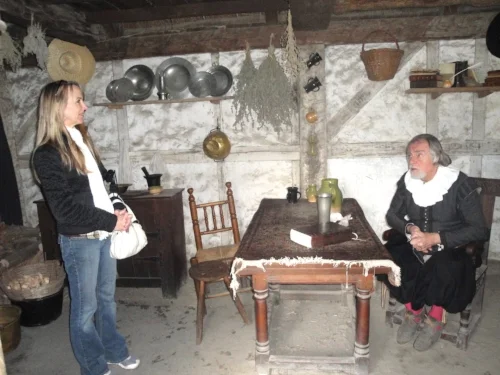
As we walked from home to tiny home, I observed the sparsely furnished insides. Things carefully chosen when they packed up their necessities and sailed to the new land. Talk about experts on downsizing!
These living lean Pilgrims are the ones who gave us what became our Thanksgiving holiday. In contrast to our material goods, they had very little to be thankful for.
But, does having a lot make us more thankful? In a word, no. Our gratitude doesn’t exponentially increase along with our accumulation of possessions. In fact, just the opposite can occur when the abundance creates clutter, stress, and discontentment.

Photo by Pixabay: https://www.pexels.com
Have you ever walked into a hotel room and felt the “ahhh” of clutter-free space? You bring your personal necessities; the hotel provides the rest— and that’s all there is! No pile of stuff taunting you. No closet so crammed that you can’t hang the clean laundry. No decision fatigue because you only brought three pairs of shoes.

I'm not ready to reduce my wardrobe to what would fit on three hooks like the Pilgrims, but I do want to be vigilant and not allow my stuff to turn my gratefulness into grouchiness. Here are some clues when you might be crossing the line:
You cringe when you open your hall closet.
You drop the bags of groceries on the pantry floor in frustration because there’s no room on the shelves.
You feel guilty about making excuses for not hosting the family gatherings due to the clutter.
Clean clothes remain in a pile because there’s no space to hang more stuff. They now require ironing. Ugh!
You avoid certain rooms or areas of your home.

Now imagine the opposite.
You can easily find and access what you need in your closets.
Your kitchen pantry has ample space for current groceries.
You gladly open your home to friends and family.
Your clothes are all hung up and you can easily walk into your closet.
You open every door without stress and shame.
How does that feel? Does it make you feel grateful? This is the dichotomy—too much stuff and feeling grateful. There’s no harmony between the two. During this season of Thanksgiving, I encourage you decrease the overflow and increase your gratitude ratio.
The Pilgrims remind us that it is not the amount of possessions that determines our ability to be thankful. Open the closet or cabinet door and let go of the stuff you don’t need, use, or love and that will open the door to more gratitude as well.
Another way to increase our gratitude ratio is to be intentional about giving thanks. This month I'm offering a free download that includes 27 questions to prompt thoughts and conversation about things we’re thankful for. Here are a few ideas on how to use them:
Create a gratitude journal by recording the answer to one question per day.
Use the questions to prompt prayers of thanksgiving.
Keep the list near the dinner table and choose one question as a conversation starter when having family dinners.
Cut up the list and put the slips of paper in a basket or bowl. Have your Thanksgiving guests each pick one and share their answer with the group. If you have more than 26 guests, make duplicate copies of some of the questions.
CLICK HERE TO DOWNLOAD:
I'M THANKFUL FOR...
wise words
“Give thanks to the Lord, for He is good. —King David”

Photo by gibblesmash asdf on Unsplash
Six Steps to Increase Productivity
The other day I decided to stop and buy some fruit. I decided to get it at Sprouts. I decided which parking place to use and which cart to grab. Out of the plethora of apple varieties, I decided on non-organic Fuji. I also decided to buy Bartlett pears, Yellow peaches, and Cherry tomatoes. On the way to the register, I decided to stop and check out a “buy one, get two free” promotion for Nut-Thins. Naturally they offered five flavors, so I decided on three. I decided which register line to stand in and, after watching the guy in front of me use his iPhone to pay, I decided to use Apple Pay on my watch rather than cash, credit card, or debit. Sprouts’ tag-line is “Every Meal is a Choice.” I’d say, every meal is a surplus of choices!
When you look at how many choices are involved in a simple trip to Sprouts, it’s no wonder our society is experiencing decision fatigue. Equal to the overwhelming quantity of decisions we’re faced with each day, there’s the fear of making the wrong choice. If there are only two types of apples, you have a 50/50 chance of choosing the best. When there are more than twenty choices, you might make the “wrong” choice twenty more times.
If, like me, you desire a peaceful and productive existence, how does decision overload impact your productivity? Here are some lessons from my Sprouts trip and six Timely Tips to increase your productivity.
TIMELY TIPS - to increase productivity
1. Prioritize. Fruit is what I needed. Deciding what I need before stepping into the store makes better use of my time than wandering the isles. When we don’t prioritize our tasks, it’s easy to be overwhelmed by a list of random things we need to do. We walk into our office, or have a day for home projects, but with so many choices we end up using our time on menial things instead of what’s most important. Keep a short, doable list of to-dos with your top priority clearly identified so you can jump right in when it’s time.

2. Block Time. From 4:15-5:15 PM is my errand time— Sprouts, bank, drop off donations, pick up mail, allergy shots, etc. By blocking time for specific tasks, you reduce the overwhelm of trying to decide when you’re going to accomplish things. Click HERE to download a free copy of the "My Ideal Week" form. Use it to outline your ideal week. Block time for the necessities and your priorities. Put them on your calendar and follow through with your predetermined use of time.
3. Create Boundaries. Might I have found a better sale price on some of the fruit if I had researched all the ads or gone from store to store? Perhaps, but for me the benefit wouldn’t outweigh the cost. Making those choices isn’t always easy. While writing this article, it was challenging to limit my time researching decision overload—so many interesting articles! Whether you’re online shopping or gathering info for a project, the internet offers never-ending choices. To be productive, we must choose a limited number of resources or create time boundaries for research.

4. Deadlines. We were down to our last few apples in the fridge making the shopping trip a must. When we have unlimited choice as to when to complete something, it often doesn’t get done. If a task or project is important, but has no deadline, impose one on it. One of mine is getting the last two years’ Christmas photo books done by this Christmas. Giving myself a deadline and blocking some time helped me get Christmas 2016 done. One more to go!

5. Routines. Even though there were 20+ options for apples, I didn’t look at every type before choosing mine. I went straight to the Fuji bin, checked the price, and loaded up the bag. That’s my routine. That’s not to say I’ll never try another variety, or that you should never step outside your established routines, but having some routines will save you time and brain energy for the more important decisions in life. For example, you might create a menu routine—Monday chicken, Tuesday Italian, Wednesday soup, etc. (click HERE for a free copy of the Meal Planner form). You might try a wardrobe routine—line up outfits in your closet to reduce the number of decisions you need to make while you’re getting ready each day.
6. Good Enough. In the apple display there were several undesirables (which surprised me since it’s apple season!). To search for a bag full of “perfect” ones would have taken awhile. As hard as it is for many of us to admit, perfect isn’t always best. I often struggle with spending way too much time trying to perfect my blogs. "Good enough" is a lesson for my productivity as well. I hope this blog has been "good enough" for you to glean some helpful tips!
Comical Words
“I organize my priorities into three categories. Things I won’t do now. Things I won’t do later. Things I’ll never do. -Unknown”
The Hub of Your Home
Hub. It’s a funny word, but descriptive of where most of life’s stuff lands. You know, the flat surfaces in the kitchen/dining area. It’s the area of activity where we come and go and make plans, make meals, and make messes. Dictionary.com defines hub as "the effective center of an activity.” Whether you’re single, married, or a family of eight, there's activity and stuff that needs to be managed.
You may think you're the only one who struggles with keeping your hub "effective." Since we don’t usually drop by other people’s homes unannounced, they've had time to push the contents of the table and countertop into a bag and stick it in a closet, pretending it doesn’t exist. Maybe that’s been your mode of operation as well.
The problem comes when three weeks later, “Where’s that form I needed to fill out?” Or, “Did I miss paying the mortgage-- again??” Or, “How come I didn’t know you had a field trip today?”
Today's Timely Tips provide ideas to reduce the clutter and create a more effective hub.
TIMELY TIPS - for an effective center of activity
LOCATION
Keep the items you need for your activities near the center of activity. Here are some ideas to consider.

Kitchen Desk: If you're fortunate enough to have a built-in desk in your kitchen, clear it off and prepare it for use.
Converted Closet: Think outside the box. Krista at TheHappyHousie.porch.com created an efficient and beautiful hub in a centrally located closet.
Kitchen Cabinet/Countertop: Chris at Justagirlblog.com created space in a kitchen cabinet attaching pegboard inside one door for keys, and a magnetic board on the other. A holder for active paperwork sits below on the countertop.
Wall: A blank wall or side of the fridge can also house most items needed for an effective hub. Meredith at Unoriginalmom.com created this space.
PROCESSING MAIL/PAPERWORK
Paper piles allow you to only see what's on top. Shift your thinking to horizontal=hidden and vertical=visible. Label folders for mail and active paperwork: Action, Bills, Events, File, Read, Receipts, etc. Use your calendar to record when to do related tasks and which folder it’s in. No more searching through multiple piles, or forgetting to do the important things!
Place your folders near where the mail tends to land. This may be in a holder that sits right on the countertop or kitchen desk.
If counter space is limited, consider a wall-mount holder.
A daily routine of sorting mail and paperwork into your folders/recycle/shred will keep the piles from forming and becoming overwhelming.
NOTES, LISTS, & CHARTS
Are you constantly grabbing the back of an envelope for your grocery list, or scribbling a note on whatever you can find? They land in one of a million places which results in a slight chance of recovery when needed. The key to effective notes and lists is to constrain them to fewer places and have them accessible when needed.
CLIP BOARDS: This hub by Jenna Burger Design includes clipboards (bottom right) that can be accessed by all family member to leave notes or add items to shopping lists. Dry erase boards are also effective.
SHOPPING LIST: My favorite shopping list method is a free app called Grocery IQ. Most of us have our phones with us all the time, that means you can add to it anytime, and it will always be with you when you are out and about. You can synch it with family members' phones and it saves specific product information like the type of printer ink, vacuum bags, or make-up you use.
NOTE APPS: There are a plethora of note-taking apps, like Evernote. Choose one that will make your hub more effective as it reduces paper and allows you to easily "search" for pertinent notes without getting out of your chair.
PAPER NOTES: If you're more of the pen and paper type, consolidate your notes to one notebook to simplify your life and hub. Purchase a 5.5 x 8.5" spiral notebook that you can use in your hub and take with you. Put the date at the top of the page you're using and record all of that day's notes on that page. Don't tear them out so you can refer back to them as needed without searching all over the house. Keep a paperclip on the current day’s page so you can quickly turn to it.
REMINDERS: This is probably the most transformative use of my smart phone I've made in recent years. The iPhone comes with a Reminders app, which is what I use, but you can use Google Keep with the same function on Android phones. Forget the to do list and use "reminders" for getting things done. I speak into my phone, "Remind me to call Scott at noon." At noon the reminder appears on my screen. I say, "Remind me to water the garden when I get home," and poof, it pops up on my phone when I pull in the driveway.
CHARTS are another great tool to keep in the hub of your home. Household chores, kids' routines, and meal planning charts all contribute to an effective hub.
CALENDAR: Tracking activities can be accomplished digitally (Google Calendar, Cozi) or on the wall of your hub with a dry erase calendar. Vanessa at seevanessacraft.com has the pens and supplies hanging below for easy access.
Wise Words
A place for everything and everything in its place. --Mrs. Beeton

Thriving Through Transitions
Children are masters of transition. I’ve seen my four-year-old granddaughters transition from 4 lb. helpless babes, to girls who ride their scooters, swim, and say things like, “I’m satiated,” when they’re full at dinner-time. (Yes, their father’s a teacher.) Imagine the countless challenges and transitions their minds and bodies endured in just four years.
Whether you’re four or ninety-four, life is full of transitions. Sometimes they intrude on us like a ton of bricks. Just this week I spoke with six people who were staggering under the weight of transitions relating to career, health, death of a loved one, relationship failure, finances, and a house flood disaster/remodel.
While only the house disaster directly caused disorganization in the home, all transitions can contribute to clutter and chaos. Even positive ones like moving to a larger home, getting a promotion, or starting a family can upset the norm and disrupt your organized household. Physical and emotional well-being is also compromised during transitions. There’s no one-size-fits-all simple three-point plan that guarantees a successful transition, but below are some Timely Tips to help you manage and thrive.
TIMELY TIPS - for thriving through transitions
1. Reach Out
What does a baby do when learning to walk? He reaches out for something or someone stable to hold on to. That’s smart, but as adults it’s hard to do. It’s easy to isolate, thinking you’re the only one struggling with this, or that you should get through it on your own.
King Solomon once said, “There’s nothing new under the sun,” and “a wise man seeks counsel.” In other words, many have gone through similar transitions and there’s wisdom in not going it alone.
Reach out to someone you trust who will guide, support, and inspire you. If you’re a person of faith, pray and reach out to your faith community. Consider an online support group or seek professional services.
2. Receive
It’s truly more blessed to give than to receive, but unless there are people willing to receive, no one is blessed. Friends and family may not know how best to come alongside you, but when they offer, be prepared to receive and if they don’t, be prepared to ask.
No doubt there are things that are going undone while your focus is diverted to the change in your life. It may be the yard, the laundry, or reading to your toddler.
Accept that during this transition you’re not going to maintain all that you were doing before. Take ten minutes to make a list of things that others could do and be willing to share your load.
3. Reorder
If clutter and chaos have ensued, consider some simple steps to regain order. Focus on the necessities. Paying the bills, eating, and sleeping.
To keep the lights on and minimize clutter, make sure you have a simple way to process the mail. Place three paper trays and a recycle bin close to where you bring in the mail. Label the first tray “Take Action” for your bills to pay, doctor forms to fill out, dates to record, etc. Label the second tray “Holding” for things you may want to look at, but don’t require action. Label the third “File” for items that need to be saved like insurance policies and tax documents.
To avoid overwhelm choose to retrieve your mail daily and do a two-minute sort into your three trays and recycling bin. Forget about saving coupons and catalogs for the time being. Keep it simple and focus on the basics. Set a reminder on your phone or calendar twice a month (1st and 15th) to sort through the Action tray and follow through with those items. Don’t concern yourself with the other two trays for now.
If your transition has impaired your eating and sleeping, you’ll struggle to thrive. Give yourself one small goal at a time. Maybe it’s an apple a day or choosing the salad bowl or grilled chicken wrap when picking up fast food. Daily fuel your body with a nutritious breakfast bar or smoothie, even if it’s on the run. Set an alarm on your phone to establish a bedtime. These routines will reduce your stress and improve your brain function.
4. Remember
Remember to do those things that renew and rejuvenate you. Recall the times you’ve triumphed through transitions. Think about what you have right now that you're grateful for. Shift your focus to these things before you go to bed and first thing in the morning. It will help lighten your load and clear your mind.
Living Smart Guides
When Deborah Dillon survived a brain tumor she discovered, "Everything had changed, but nothing was different." Her experience transformed her perspective and thrust her into a challenging transition that would lead her to sell a successful business and start a non-profit called Living Smart Guides.
Some transitions in life are inevitable. LivingSmartGuides.com is a comprehensive and FREE RESOURCE CENTER that provides the information and tools necessary to prepare for the expected and unexpected. It offers over 80 free forms that you can print or complete on your device. You can save, change, and electronically share the forms with friends and family.
You can read more about Dillon's experience at The Living Smart Story.
Wise Words
Transition is the natural process of disorientation and reorientation that marks the turning points in the path of growth...transitions are key times in the natural process of self-renewal. --William Bridges

Photo by Jonathan Borba: https://www.pexels.com
One Last Gift
“…in this world nothing can be said to be certain, except death and taxes.” –Benjamin Franklin
It’s interesting that with a 100% mortality rate, very few of us take time to prepare for death the way we do for taxes. Perhaps it’s because, when it comes to death, there’s no “April 15th.” Each of us has an unknown deadline and unfortunately, we can’t apply for an extension.
We also don’t contemplate who the preparation is for. While spiritual preparation is for ourselves, the physical preparation is not. It’s for the loved ones we leave behind. Some family members receive “the call” and experience the nightmare of rummaging through piles of papers, searching for essential documents, planning a funeral without knowing the wishes of their loved one, and all the while feeling paralyzed by grief. It’s a painful and overwhelming task that none of us would wish for those we love.
Since we don’t know when our eleventh hour will come, now is the best time to prepare. It is our one last gift to those we love.
These Timely Tips are not exhaustive. It’s always necessary to confer with a licensed attorney regarding your own essential documents.
TIMELY TIPS - for one last gift
Documents to prepare:
Will or Living Trust
Advance Directives (DPA - Durable Power of Attorney, Healthcare Power of Attorney, DNR -Do Not Resuscitate, Organ Donor)
Asset Inventory
Valuables Inventory
Monthly Income and Source
Emergency Care Authorization Forms (for dependents)
Pet Care (Arrangements/Veterinarian)
Documents to compile:

Birth Certificate
Marriage Certificate
Civil Union Documents
Divorce Decrees
Child Custody Decrees/Agreements
Property Deeds/Trusts
Vehicle Titles
Military Records
Social Security Card & Benefit Records
Driver’s License - copy
Passport
Employee ID
Medicare/Medicaid Cards - copy
Tax Return Archive (7 years - location of)
Current Year Tax Documents (location of)
List of contact info for:
Executor
Attorney
Accountant
Financial Advisor
Insurance Agent
Employer
Retirement Plan
Clergy
Physician
Notification of family, friends, neighbors, coworkers
List of accounts, policy numbers, passwords, signatories for:
Insurance Policies - Life, Health, Dental, Disability/Long-Term, Homeowners, Auto
Pensions/Memberships with Survivor Benefits
Automatic Deposit Authorizations
Automatic Withdrawal Authorizations
Annuities
Bank Accounts
Pension
IRA/401k
Investments/Stocks
Mortgage
Credit Cards
Loans
Time Share Agreement
Service Providers and other bills
Medical Records
Email
Social Media
Electronics’ Access Codes
Off-site Storage
Consider using an online service like MINT.com that stores and connects to your accounts.
Record location information for:
Valuables (include on inventory list)
Copies of keys for vehicles, home, safety deposit box, off-site storage
Final Disposition
Record your wishes/plans and payment information for:
Funeral Home
Cremation (location of ashes)
Burial (location)
Grave Marker
Service
Keep in mind that a service is another way to look after your loved ones in their grief. It’s a time for people who care about them to come together and offer their comfort and support. If you'd rather not have one, record your wishes but, give them permission to make that decision when the time comes.
Record your wishes for the following:
Type of Service(s) – Viewing, Wake, Graveside, Funeral, Memorial
Funeral – clothing/jewelry, type of casket; open/closed casket, pallbearers
Service Location
Clergy/Religious Preference
Readings/Scripture
Photos (choose one for newspaper, if desired)
Music
Flowers
Memory Table Items
Donation recipient in lieu of flowers
Program (photo, scripture, poem)
Reception
Don’t feel you need to script the whole thing. Provide some ideas to help reduce the number of decisions required by your family.
Legacy
What are some of aspects of your life you’d like your family and friends to remember? Record some accomplishments, career highlights, community service, military experience, spiritual journey, and special memories about people, events, and places you’ve experienced. Your family will treasure these and may draw from them to create your obituary.
Create a short list of your most precious belongings. You may designate them to individuals or families, if desired. Give your family permission to keep what’s most precious to them and let go of the rest. This is the icing on the cake of your one last gift!
Storage
Once you’ve compiled this info, scan and save, and/or make copies of the documents (See LivingSmartGuides.com for forms). Back up your computer files on an external hard drive or flash drive. You may also choose to store them in the cloud. Organize the original hard copies in a locking fire-safe security file or, place them in a file tote in a safe. Make sure your executor and trusted family member or friend have copies of or access to all of the above.
LivingSmartGuides.com is a comprehensive and FREE RESOURCE CENTER that provides the information and tools necessary to prepare for the expected and unexpected. It offers over 80 free forms that you can print or complete on your device. You can save, change, and electronically share the forms with friends and family.
I highly recommend you check it out before beginning to prepare your "one last gift" and consider using the Living Smart Guides forms to compile your information. You'll also find the founder's story fascinating at The Living Smart Story.
Wise Words
Planning is bringing the future into the present so that you can do something about it now. --Alan Lakein

Photo by Eva Darron on Unsplash
Up, Up and Away!
Some people have all the luck. This time it’s me! Imagine you get a call—free round-trip airfare to Hawaii, free accommodations and food, plus you get paid to be there! Scam? No, a client looking for some organizing assistance after moving to Honolulu. OK, so I’ll have to do a little work while there, but waking up for work in Hawaii has to beat waking up here, right? If you’re preparing to fly away this summer like I am, here are some Timely Tips for your trip.
TIMELY TIPS - for airline travel
PREPARE

TRAVEL INFO - Label a large plastic envelope for your trip information and resources. This can house your reservation confirmations, tickets, packing checklist, photocopies of your prescriptions, passports, postcard stamps, as well as brochures and memorabilia you collect while on your trip.
PHONE APPS - For a more techy version, consider using Tripit, TripCase, or the Kayak app to store and access your itinerary, confirmations, tickets, etc. on your phone.
PREPARE HOME - Put a hold on your mail (www.usps.com) and newspaper subscriptions. Arrange care for pets and plants. Put house lights on a timer and secure valuables. Give your contact info and itinerary to a neighbor/friend.
ALERT CREDIT CARD COMPANY if traveling abroad so it’s not flagged when used far from home.
PAY BILLS - that may be coming due while you're gone.
PACK
MINIMIZE - Pack only what you absolutely need. I’m the first to break this rule when traveling by car, but when flying, excess costs time, space, and money! Use a packing checklist available online or create your own. Use your itinerary to guide your wardrobe choices.
LIQUIDS' RULE - TSA's 3-1-1 Rule requires carry-on liquids to be 3.4 ounces or smaller and fit together in one clear quart-sized resealable bag. When possible replace liquids with an alternative like make-up remover cloths or solid bug repellent and sunscreen stick.
REDUCE - Find out what amenities your hotel offers (hair dryers, beach towels, shampoo, etc.) so you don’t pack things they provide. If you need to bring beach towels, shrink them using Travel Space Saver bags—no vacuum needed. You can also use these to shrink your dirty laundry for the trip home. Unfortunately, you’ll still have the same number of loads to do once you’re back.
SHOES - Use the inside of shoes to pack small items stored inside resealable bags. Put shoes in gallon-size resealable bags and place them near the wheels of the suitcase so they don’t crush clothing.
ORGANIZE - Use packing cubes or extra large Ziplocks (2 gallon work) to keep your outfits or categories of clothing organized within your suitcase. Roll soft clothing to maximize space. Pack some extra Ziplock bags for wet suits, snacks, etc.
JEWELRY - To protect necklaces from tangling, thread them through straws and place them in resealable bags or toothbrush holders. Store rings and earrings in seven-day plastic pill holders or in snack-size resealable bags pinned to the corresponding outfit.
CARRY-ON
In order to be prepared for lay-overs, lost luggage, etc., be sure to pack the following in your carry-on bag:
Snacks
Prescriptions
Printed tickets, confirmations, passport, ID
Valuables – camera, jewelry, computer
A change of clothes/underwear
Small selection of toiletries (See Liquids' Rule)
Chargers
SECURITY
SECURITY CHECK - To expedite the security check, bring car keys, loose change, money clip, belt, cell phone, pens, jewelry, etc. to airport in a clear resealable bag. Once you’re cleared, relocate items to your pockets, purse, etc.
BAGGAGE - Consider using a TSA Luggage Lock to secure your suitcase en route and at your hotel. TSA can open it without breaking the lock and re-lock it when a search is complete. Tie a brightly colored luggage tag or ribbon to your suitcase to distinguish it from the other 50 black suitcases on the baggage carousel.
RETURNING HOME
UNPACK - Of course you won't feel like it, but choose to completely unpack within 24 hours of your return.
SOCIAL MEDIA - Now's the time to post about your trip, rather than alerting everyone that you're away from home. "Just returned..."
Comical Words
Airplane travel is nature's way of making you look like your passport photo. -Al Gore

Garage Band
What do The Beatles, Google, and old text books have in common? They've all spent time in a garage. The Beatles and Google moved out and up in the world, but those old text books? Well, they might still be lurking in a corner of your garage. Even if you’re able to squeeze in a car or two, now’s a good time to purge and organize. Who knows, if you create enough space, your garage might birth the next American Idol or a billion-dollar company! Check out today's Timely Tips for garage organizing strategies.
TIMELY TIPS - to organize your garage
SCHEDULE a couple days back to back, especially if there are unmarked boxes from three moves ago. Purge on day one and containerize on day two. Recruit some muscle and support to seal your success. Have water, snacks, and some energy-boosting tunes playing to keep you moving. Take breaks as needed so you don’t burn out.
DAY ONE
SET UP FOR PURGE. Pull out your trash and recycle cans. If you’re likely to find a lot of unusable and un-recyclable items, rent an additional dumpster from your waste disposal company.
LABEL BOXES for donate or sell. If needed, label a box with ??? for “I have no idea what this is, but it looks like it might be important.” Also have a container for "take into the house." Be very selective about what goes in there since you'll need to find homes for those items too. A few musts for going inside: photos, food, touch-up paints (just keep a little labeled jar), and paper goods.
CREATE CATEGORIES for all the keep items. Lay tarps or old sheets on the driveway for sorting onto. Make signs so your sorting categories are clearly defined. Categories may include yard care, tools, paint supplies, car care supplies, pet supplies, sports equipment, seasonal décor, camping gear, luggage, etc.
PURGE AND SORT. This means picking up each item and sorting it into trash, recycle, donate, sell, or one of the save or relocate categories. The temptation will be to defer decisions by putting things to the side. DON’T DO IT! Make the hard choices, but if you must, create a “think about it” box.
WRAP UP DAY ONE. Close up your donate/sell boxes. Schedule a Thrift Store pick-up or yard sale for the next weekend. Date your "???" and "think about it" boxes for 6-12 months out. At the end of that time, donate or sell anything that hasn't been taken out and used. Pull the tarps/sheets into the garage for night keeping your category signs intact.
DAY TWO
CONTAINERIZE. If you want your garage to have a uniform look, purchase bins before you begin. You can always return the ones you don’t use. I like the Clear Stack 3-pack 45-quart bins from Costco (pictured in the Before/After pic), or these 44 quart Ziploc bins from Home Depot (pictured above). Their size and shape make them easy to handle. You’ll likely need a few larger ones as well.
If you did a good job purging you can use your own empty bins, instead of buying new. Avoid using cardboard boxes. They don’t protect their contents and are vulnerable to bugs and rodents.
Containerize and label according to your designated categories. For example, your “PAINT SUPPLIES” bin may store your paint brushes, rollers, masking tape, trays, tray liners, stirrers, drop cloths, etc.
SHELVING is a must for easy access to bins. Closed cabinets keep things a bit cleaner, but open shelves work well too. Make sure you measure and assemble your shelves so that they accommodate your bin size.
Keep like things together by placing your bins on the shelving according to their categories. Use the middle shelves for bins you use most. For rarely used items and seasonal storage, consider sturdy shelves that mount to the ceiling.
For easy access to frequently used items, place the lid under the bin, or if it's a large item it can sit directly on the shelf.
PEGBOARD. Not everything is best suited for bins. Create a home for tools in an organized tool box or on a pegboard. Accessorize your pegboard with hanging shelves, bins, and hooks. Designate what goes where by outlining each tool once it’s hung. You can also use a magnetic strip to hang your frequently used screw drivers, pliers, measuring tape, etc.
TRACKS. Wall-mount track-based systems are great for hanging everything from ladders, bikes, and garden tools, to extension cords, fishing supplies, and wheelbarrows. Attachments include shelves, baskets, hooks, and specialty containers for sports equipment. The attachments can adjust to your family’s changing needs. A couple of long nails will also hold your yard tools in place on the wall.
PARKING. Now that you’ve cleared space, map out designated parking for kids’ bikes, wagons, and scooters using colored duct tape on the floor and pictures on the garage wall. (I'm an Organizing Junkie idea!)
To ensure you park your cars correctly, hang a tennis ball from the ceiling. Place it so it touches the center of your windshield when you’re in the right spot. Or if you’d rather, you can leave the cars out, and set up your drum set for band practice. Maybe you’ll be the next Ringo!
Fun Fact
The word “garage” is derived from the French word “garer” meaning to protect, shelter, or store. How's yours doing?

Engineering Hope
“Isn’t it time for you to leave yet?” I’ve learned not to take it personally when my clients say that. And some of my favorite clients do! To do my job I must, at times, hold my clients’ feet to the fire. This comes in the form of keeping them on task and asking questions. Questions with predetermined answers that are challenged with more questions.
Me: Do you need this?
Client: Yes.
Me: How long has it been since you used it?
Client: I don’t remember.
Me: Describe for me a scenario in which you will use it.
Client: Hmm…
People don’t hire me because they want things to stay the same, but that doesn’t mean they’re excited about making changes. Even with obvious benefits like finding things easily, clearing a room full of boxes, or walking into a walk-in closet, change doesn’t come easily. There are obstacles that they, and perhaps you, face in the process of change. Here are some timely tips to help you tackle the challenges and win!
TIMELY TIPS - for organizing success!
“My identity is connected to my stuff.” This is one of the hardest things for teachers. You’ve poured your life, energy, time, and money into creating and preparing teaching materials. Teaching is far more than a job. It’s who you are. And now, in retirement you have to dump it all? Well, no. How about snapping photos for a photo book, or creating a scrapbook with a few pages from your favorite units? Check with your neighborhood school, private schools, or Home School Groups to see what materials might be useful to them. Join a retired teachers Facebook group and ask for ideas. Create space for a new identity to form as you pursue your retirement goals and dreams.
Maybe you weren’t a teacher, but you’re storing books, binders, and miscellaneous paraphernalia from a former career. Keep a small portion for reference or remembrance sake, pass along resources of value, and recycle the rest. Allow your legacy to be based on the people your goods and services helped, rather than how much stuff you’ve saved to show what you did.

Shadowbox Keepsakes from Grandparents
“I don’t want to go there.” One of my clients had lost all the members of her immediate family. As she and her husband prepared for a move, she knew she couldn’t sell the house before reducing a lot. With tears we sorted through her parents’, sister’s and her own belongings. It was a painful and dreaded process for her. As she pushed through, she cleared the clutter from her physical space, as well as her mind and emotions. After many months, we completed the job. Her house looked great and sold quickly. When we said our goodbyes she brought me to tears. “You gave me my house back,” she said. “No, you gave me my life back.” She was ready now to move on to a new and fulfilling place and purpose.
If you’re facing a daunting task, the key is giving yourself scheduled time, accountability (someone that can help you reach your goal without making it worse), and grace. Keep the things that bring you the most joyful remembrances. Bear in mind that it’s not the quantity of keepsakes that honors your loved ones. Saving fewer things that are used and displayed gives value to the items and the people they represent.
“It will never work.” You’re convinced you’ll never finish, never get it just the way you want, or never keep it that way. Recently my son-in-law was working with my 4-year-old twin granddaughters and their baby sister, rehearsing their getting-ready-for bed routine. Remembering all the steps can be overwhelming, so they use a chart with pictures. In addition, he talked with them about taking it just one step at a time, like eating an elephant, one bite at a time. Now, when it’s time for bed baby sister says, “Eat elephant!”
When learning to ski there’s a bunny hill for beginners. When learning to play the piano, you don’t sit down with the score of Beethoven’s Fifth Symphony. Likewise, when beginning to organize don’t bite off more than you can chew. Start small. Choose one flat surface, one drawer, or one shelf. Purge, organize, and create routines to keep it that way. Once you enjoy success with that area, take the next bite.
In their book Switch, Chip and Dan Heath say, “When you engineer early successes, what you’re really doing is engineering hope. Hope is precious to a change effort.” Whatever your organizing project is, I encourage you to start small. Succeed. Move on and keep your bites manageable. Eat elephant!
Wise Words
Optimism is the faith that leads to achievement. Nothing can be done without hope and confidence. --Helen Keller

What's Behind Door #1213
In my 10+ years of organizing, I’ve never heard someone speak with fond remembrance about the process of clearing a deceased parent’s home, much less a storage unit that held all the stuff their parents could live without but couldn’t part with.
And yet, the need for self storage units increases. From its humble beginnings in the 1960s, the self storage industry has grown to an annual revenue of $38 billion (The SpareFoot Storage Beat).
While some units are used for business purposes or temporary use, many are storing the over-flow of personal households. Tom Vanderbilt refers to these units as “The catacombs of consumerism” in his article Self-Storage Nation.
You may not be contributing to Derrel’s Mini Storage empire, but you likely know someone who is. If you share this info, they might take you out to dinner with the money they save! Here are some questions to consider before paying next month’s rent.
TIMELY TIPS - to put money in your pocket (instead of Derrel's)
ASK YOURSELF:
How is having the stuff in storage benefiting you? Not, how did it benefit you in the past when you were using it, but how is it benefitting you now to store it?
What feelings are aroused when making the monthly/quarterly payments? Are you happy to be paying that monthly fee because the items you’re storing are worth so much more to you than $700-$1000/year?
What’s in your unit? Do you remember? Having helped a number of clients close down storage units this past year, I can almost guarantee that if you’ve had it awhile, you’re not sure what’s in it.
What’s your long-term plan for the items you’re storing? Is it to wait until it becomes your children’s problem?
If storing things for your adult children, have you asked them if they want those items? If they do, what’s the time-frame for passing them along?
When would be a better time to work on it, when it’s 75 or 105 degrees?
You get the picture. There’s no better time than now to open up that puppy and begin the purge.
HERE'S HOW:
Schedule a date(s) and stick to it.
Have an able-bodied partner to help you.
Bring garbage bags labeled “Trash” and “Recycle.”
Bring a folding table and chairs if you have lots of boxes to sort through or bring the boxes home for sorting. (You may prefer to do it there, if they’re dirty.)
While sorting, identify larger items and boxes for donation with a certain colored sticky note. Use a different colored note for items to return home. That way, if you don’t finish the project in a day, you can easily see what’s been previously sorted, and what’s left to do.
Before bringing an item back home, think through where it will land. If you don’t have a place for it, consider letting it go, or letting something else go to make space for the more valuable item.
If, at the end, your donation pile is more than what will fit in your car, consider scheduling an appointment with a thrift store to meet you there and pick it up.
If you have items belonging to others, give them notice that you’re not renewing your unit after a specific date, so they can retrieve their things.
Using the money you saved, schedule a weekend away a few months after closing your unit to celebrate your accomplishment!
Wise Words
...life does not consist in an abundance of possessions. --Jesus Christ
Lose 30 Pounds in a Day!
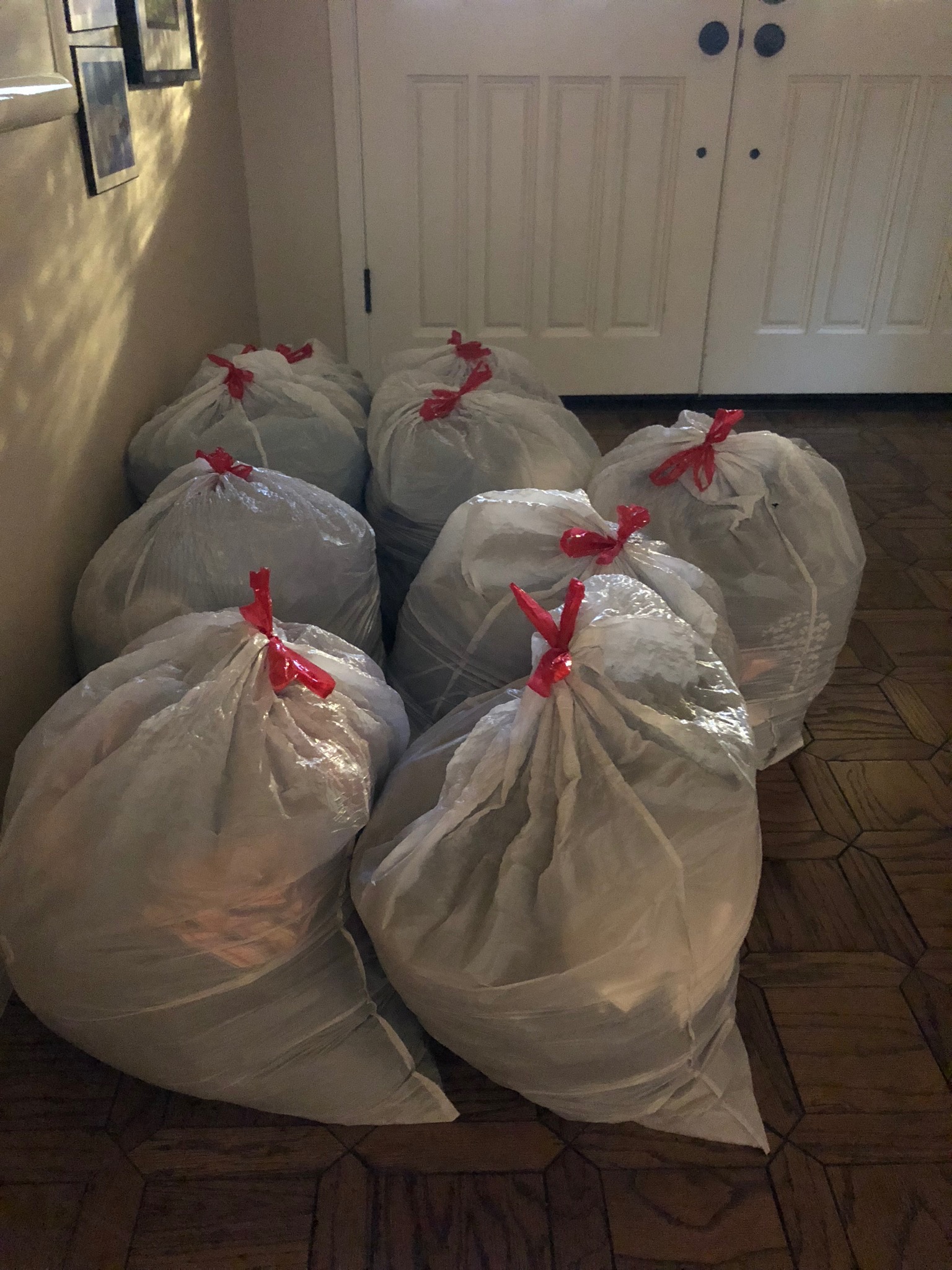
Lose 30 pounds in a day! Most of us could do it. Maybe even more. All it takes is time, honesty, and a little ruthlessness. I helped two clients do it last month. In fact, they each had more than five garbage bags of clothes to donate when we were done. Oh, did I fail to mention I was referring to 30 pounds of clothes?
How many times do you enter your closet and think, “I don’t have anything to wear,” while the closet rod is sagging under the weight of all your clothes? I’m convinced that in those cases, we don’t need more, we need less. What if you were able to walk into your closet knowing you enjoy wearing everything—it fits you well, it’s the style you like, and it looks good on you?
You CAN have a closet like that! Check out today's Timely Tips for clothes purging and organizing ideas.
TIMELY TIPS - to get your closet in shape!

Schedule a time - Block out 3-6 hours depending on the size of your closet. Schedule breaks so you don’t have a melt-down before finishing. Plan a reward (other than shopping) to enjoy at the end of the day.
Catch up on your laundry before you start so you’re not missing anything in the process.
Purchase matching hangers. I prefer the slim-line velvet hanger for most tops. T-shirts and frequently worn sweatshirts work best on the slim-line plastic finish. The open-ended hangers for pants are great—so easy to use!
Make sure your closet has adequate light. If your bulbs are dim, it can lower your mood and make choosing what to wear in the morning more of a chore. If it’s not a walk-in closet, and didn’t come with a light, install a battery-operated stick-on light.
Plan categories for the clothing you keep. Sort by type (pants, shirts, jackets, dresses), use (work, casual, dressy, workout), color, or season. I prefer by type and color to make them easy to retrieve.
Clear the closet floor of other items such as shoes, purses, bags of purse contents, etc. Save the purging process of these for another day, but get them out of the way, so you can easily move in and out of the closet.
Make your bed to use as a staging area. Pull out all your clothes (off the closet rod, floor, chairs, etc.) and lay them in piles on the bed. Use a sheet on the floor for the overflow, if needed.
Pick up one item at a time. Be honest and ruthless. Most of us are equipped with excellent rationalizing skills that can sabotage the purging process. You’re on a treasure hunt for only the items you’ll be anxious to wear. If it’s something you love and wear regularly, it gets an automatic pass back to the closet.
Hang your keepers backwards. As you’re re-hanging your treasures, use the most accessible area of the closet for the clothes you use most. Hang them in your predetermined categories with the hangers facing backwards. After an item is worn, you may hang it the right way. This will help you identify clothing you thought you wanted, but never wear, because they’ll still be hanging backwards at the end of the season.
Beware of faulty reasoning. As you continue the purge, don't succumb to, "But it still has the tags on it!" Apparently, that means you aren’t wearing it. Even if it was expensive, it’s not adding value to your life by taking up space in your closet, and someone else could get good use out of it. Donate or consign it.
Not your size? Limit the number of items you keep in a size that you’re planning to wear again, but not fitting into presently. Place a few favorites of that size(s) in a bin and put them under the bed or on a shelf, so they’re not mixed with your current size.
Needs repair? Place items you love, but need repair, in a bag or bin. Give yourself one month to get it done. Whatever’s left at the end of the month, goes. Clothing, even items beyond repair, can be dropped off at H&M clothing store for repurposing/recycling.
Try them on! You’ll probably run into items that you’re just not sure about. Don’t just ponder them on the hanger, try them on. Then ask yourself, would you buy it again if you were trying it on in the store? Would you be happy to wear it the rest of the day, or out that evening? Remember, you’re on a treasure hunt.
Identify your preferences. Look at the items you’ve already returned to the closet. What makes them treasures—style, color, fit, easy maintenance? Identifying what you love about them will help as you filter through the rest of your clothing.
Bag and label the donate/sell piles. Send them to their final destination. Enjoy your predetermined reward, and relish in the joy of waking up to a wardrobe you love!
Comical Words
I like my money right where I can see it: hanging in my closet. -Carrie Bradshaw

Make Your Great Room Greater
If your house was built in the early 80s like ours, you may have a great room. That was the trend. As a young married couple we thought sure, what do we need two rooms for? We discovered the answer to that, three kids later.
The other night we watched old home videos. I noticed almost all were filmed in our great room, or what we call our family room. Babies learning to walk, birthday parties, kids dressing up and performing to Disney music. So many great memories!
I also noticed how the room’s furnishings and function transitioned over the years. The piano moved a couple times, a large desk came and went, and even though I won the “no recliner” battle for years, I succumbed to a sectional with three recliners last year. At the end of the day it’s a warm, cozy place to enjoy times with family, friends, or Netflix and popcorn.
Because a family room is one of the most-used rooms, it’s likely to need some time and attention to ensure it remains inviting and functional. Here are some Timely Tips to help you do just that!
TIMELY TIPS - to make your great room greater!
Start with a general declutter. Remove trash, old newspapers, catalogs, and everything that doesn’t have a purpose or home in the family room. Then, be realistic about the fact that it’s not going to stay uncluttered. Place a large decorative basket in the corner of the room to collect items that family members leave behind. Set a time of the day or week when everyone’s responsible to take their belongings from the basket and put them away. If candy wrappers, tissues, or other trash is found, place a decorative wastebasket in the room as well.
Tired of searching for remote controls? Assign them a home using a remote-control organizer or caddy, or place them in the drawer of your coffee or end table. And while you’re in the TV/entertainment area, untangle the cords and organize them with cable clips or sleeves. Be sure to label what each one belongs to.
Use plastic bins to organize gaming gear—headsets, controllers, DVDs, etc. Divide things into categories and label bins for easy retrieval. If you don’t have closed cabinets to store them in, use decorative baskets on open shelving. If it's used frequently, consider an open-style stand like the one pictured.
Free yourself from the burden of hours and hours of magazines and newspapers waiting to be read. Purchase a magazine rack and fill it with your most recent issues. Whatever doesn’t fit, donate or recycle. Make the container your boundary and purge it as soon as it’s full. If it fills up too quickly, chances are you’re subscribed to too many publications. Drop the ones least read.
If you receive a hobby publication that you want to keep for reference, decide how much space to allot it, and purchase magazine/file holders to keep the issues containerized and in order on a shelf.
We’ve completed the cycle and have toys in our family room again. Our grandchildren’s little table and toy box are situated in a cozy corner behind the sofa so they can play without the adults’ conversation distracting them. :) Rolling storage carts also serve well for toys and can be easily relocated, if needed.
Next, tackle your movie and music collection. Some of my clients claim they still listen to cassettes, but I have yet to walk into a house and hear one playing. If your cassettes and VHS tapes are classics, consider purchasing them in an up-to-date format like a download for your computer, or at least a CD or DVD. If you don't have a VHS or cassette player, let the tapes go.
If you have home movies on VHS, transfer them to digital as soon as possible. Use Costco, or an online service like www.imemories.com. If need be, use a company that improves the quality like Digital Memory Media (www.dmmem.com). Since DVDs are not going to be around forever, be sure to have them transferred to a flash drive as well.
If the CDs and DVDs you keep are taking a lot of space, purge the ones you no longer use, remove the rest from their jewel cases, and place them in a disc binder.
Place decorative baskets under the coffee table or use ottomans with storage for throws, crafts, games, bill-paying supplies, or other activities you regularly do in the family room. If a cookie sheet can be discreetly stored under the sofa, put your stationary or craft supplies there so you can easily pull it out to work and hide it when you’re done.
Wise Words
A room designed for making memories is a room with with comfort, space, and the people and things you enjoy most. --Brenda McElroy